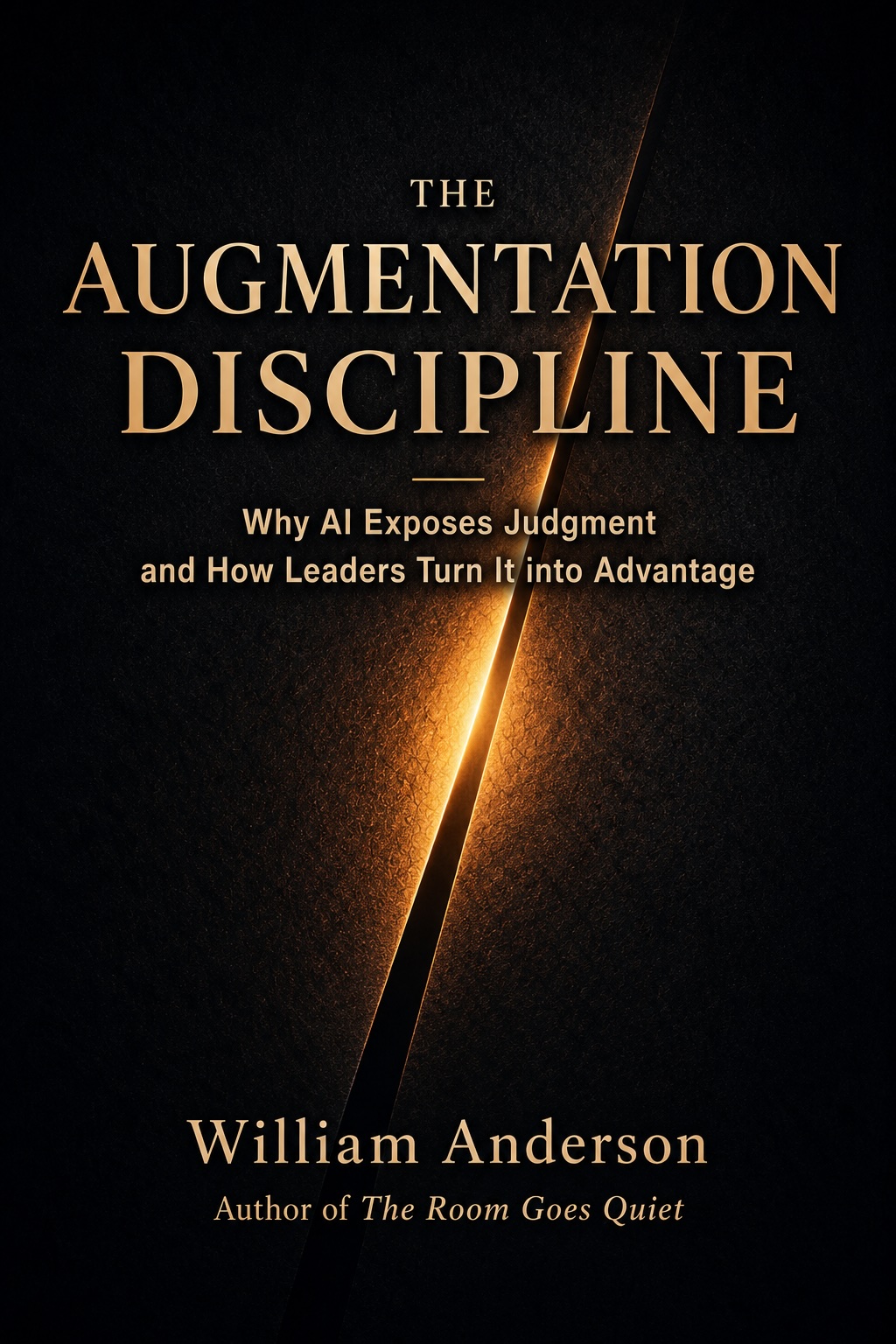
Artificial intelligence is not replacing judgment. It is exposing it — faster than most organizations can respond.
For executives, senior operators, and transformation leaders who have already been tested by AI complexity.
Second book from the author of The Room Goes Quiet.
That gap is the whole book. Artificial intelligence is not replacing human judgment — it is exposing it, and exposing it faster than most organizations can respond.
I wrote this from years inside enterprises where AI arrived before the discipline to govern it did, and from long interviews with practitioners whose judgment failures carried real consequences. Out of that came four disciplines that determine whether leaders remain the authors of their organizations' decisions or become passengers in systems they can no longer read.
Then there's the harder problem, and it's the one most organizations never get to: having all four inside one company changes nothing unless something is built to connect them. In most organizations, nothing is.
Truth is a superpower.
Only if the organization allows it to be used.
Machines cannot carry accountability. These are the four roles a leader still has to fill, and what each one is responsible for once AI is in the workflow.
AI produces incredibly polished drafts that easily mask unverified assumptions. Fluency reads as rigor, and it isn't.
Enforce an integrity loop. Verify the logic before that shiny document becomes company strategy.
Automated monitors only catch obvious failures. Subtle system drift passes straight through them, quietly, for months.
Use AI to filter the daily noise, then spend your attention hunting the weak signals it can't see.
Deploy a tool badly and people will blindly agree with it just to save time. Compliance looks like adoption on every dashboard you have.
Build internal workflows where disagreeing with the machine's recommendation is frictionless.
A decision that can only be defended by pointing at the system that produced it is a decision no one actually made. Machines cannot carry accountability, and the organization knows it.
When the AI is confident but the human context is uncertain, you own the call.
Polished work is not the same thing as sound work.The Craftsman
Perfect stability often means something is being hidden.The Operator
The default culture will eat the capability every time.The Builder
Accuracy without accountability is just hope.The Leader
Individual observation without organizational infrastructure is luck, not discipline. And luck is not a competitive strategy.
Having all four disciplines inside one organization changes nothing unless something is built to connect them. In most organizations, nothing is.Ninety seconds on the argument behind the book, and the four disciplines it's built on.
This isn't a book about using AI tools. It's for leaders who are accountable for what an organization does with them, and who will be asked to defend those decisions long after the output looked convincing.
Pre-order on AmazonSetting the terms for how AI enters the operating model
Governance and oversight when the recommendation came from a model
Owning decisions that AI accelerated but did not make
Deploying tools people will actually push back on
Counsel that has to hold up when the analysis was machine-generated
Bulk orders available for internal enablement programs
Hardcover, $35.00, covered by Amazon's pre-order price guarantee — if the price drops before release, you pay the lower one. Release-day delivery on December 29.
Pre-order on AmazonConsidering the book for a leadership team, a transformation program, or an internal enablement rollout? I can provide bulk pricing guidance and a short executive briefing.
Request PricingThe first book. Where the moment comes from, how to recognize it, and how to lead through it. Available now in hardcover.
★★★★★ 5.0 on Amazon · Heard on 4 podcasts
"When the stakes are high, people aren't just buying a product. They're buying trust and confidence in the outcome."
Idalia · Verified Amazon reviewEvery leader eventually faces the moment when the room goes quiet. The customer hesitates. The board shifts. The executive team waits. And every eye turns to you.
Most are not ready for it, not because they lack expertise, but because no one taught them to read the room, own the silence, and lead with authority when the pressure is highest.
This book is about that moment. Where it comes from, how to recognize it, and how to lead through it with clarity instead of reaction.
The room going quiet is not a problem to solve. It's a signal to read.
From The Room Goes QuietA short video introduction to the book, its themes, and what you'll gain from reading it.
This isn't a book for aspiring executives. It's for the ones already in high-stakes situations, who want to lead those moments with more clarity and less reaction.
Order from the publisherNavigating board rooms, investor meetings, and high-stakes decisions
Reading the room in governance and leadership conversations
Executive presence under pressure and across the table
High-value pursuits where the room going quiet means the deal is at risk
Client moments where your counsel is being tested in real time
Bulk orders available for internal enablement programs
Order directly from the publisher. The best path for signed and limited-run copies, and the option that supports the work most directly. Same hardcover, shipped to you.
Order from PublisherPrefer Amazon? The book is available now in hardcover, with Prime delivery and the checkout you already know. Either path gets you the same book.
Order on AmazonConsidering the book for a sales organization, leadership team, or internal enablement program? I can provide bulk pricing guidance and a short executive briefing.
Request PricingThe first chapter sets up everything that book is about: the moment, the silence, and why most leaders aren't ready for it. Get it free, no strings attached.
Enter your email and the chapter PDF will be sent to you within a few minutes. One email, no list, no follow-up.